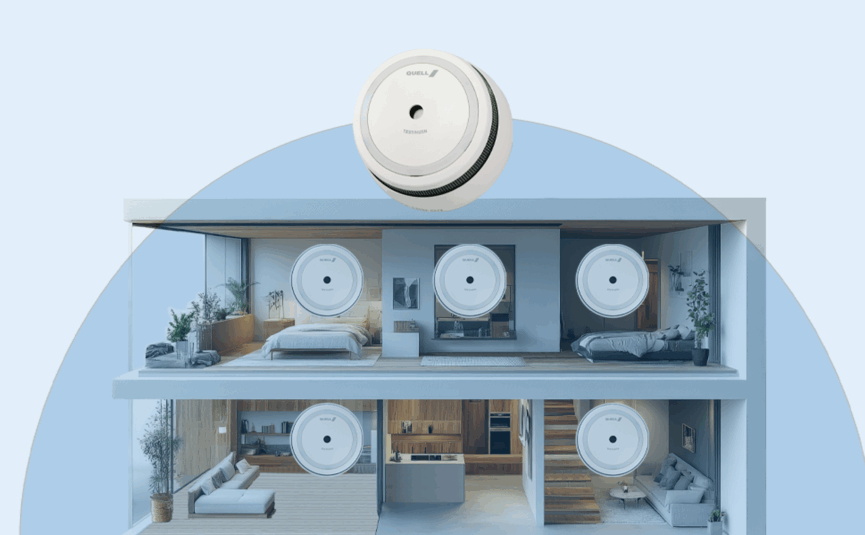
Most people assume that if a smoke alarm sounds, everyone in the house will hear it. Unfortunately, that’s not always the case.
If a fire starts in the garage while your family is asleep, the nearest smoke alarm will sound first. In a larger home, however, that warning may not be heard straight away, especially if bedrooms are located on another level or at the other end of the house.
That’s where interconnected smoke alarms can help.
When one alarm detects smoke, every connected alarm sounds, helping ensure everyone hears the warning no matter where they are in the home.
Every home has a different layout. While some homes make it easy to hear a smoke alarm from almost anywhere, others have bedrooms, living areas and garages spread further apart, making early warning even more important.
A quick self-check:
If any of these sound familiar, interconnected smoke alarms are worth considering.
There are two main ways smoke alarms can be interconnected: wireless and hard-wired.
Wireless interconnected alarms
Wireless alarms communicate using radio frequency (RF) technology. When one alarm detects smoke, it sends a signal to the other alarms in the home, causing them to activate as well.
Because they don’t require any wiring between alarms, they’re a popular choice for existing homes and come in both Battery and Mains Powered variants.
Good to know:
Hard-wired interconnected alarms
Hard-wired alarms are connected to the home’s electrical wiring and interconnected via a dedicated wire between each alarm, allowing all alarms to sound when one detects smoke. They’re commonly installed in new homes and major renovations, and installation must be completed by a licensed electrician.
If you’re upgrading the smoke alarms you already have, and they are Mains Powered you will need to replace your alarms with Main Powered alarms.
A wireless interconnected system is often the easiest place to start when creating a new interconnect network as there is no need to run cables through walls or ceilings, and you can easily expand the system later if your needs change. Adding an extra bedroom, converting the garage or creating a home office? Additional wireless alarms can simply be connected to the existing network, helping you extend protection as your home evolves.
If you’re building a new home or undertaking a major renovation, a complete hardwired or combination of hardwired and wireless may be suitable. With electrical work already being carried out, it’s a convenient time to install interconnected protection throughout the home. These systems connect to the home’s mains power and should be installed by a licensed electrician.
Do you need interconnected smoke alarms? If your home has areas where a smoke alarm might not be heard straight away, they’re certainly worth considering.
The whole point of a smoke alarm is to give you and your family time. Time to wake up, time to react and time to get out safely. The sooner you hear the warning, the sooner you can act.
Requirements can vary depending on where you live, so it’s always worth checking your local smoke alarm regulations when upgrading or installing new alarms. Interconnected smoke alarms are already required in some situations and are becoming increasingly common in homes across Australia.
In Queensland, all private homes, townhouses and units will need interconnected photoelectric smoke alarms from 1 January 2027. Requirements vary across Australia, so check the current rules in your state or territory.
Because when it comes to fire safety, a few extra seconds can make all the difference.
To learn more, explore Quell’s range of interconnected smoke alarms, browse the FAQs or visit the Video Library for practical advice on choosing, installing and maintaining your smoke alarms.
How many interconnected smoke alarms do I need?
The right number depends on the size and layout of your home. For the best level of protection, smoke alarms should be installed in bedrooms, hallways connecting sleeping areas and on every level of the home.
Can interconnected smoke alarms be installed in an existing home?
Yes. Many interconnected smoke alarms are available as wireless models, making them suitable for existing homes without the need to run cables through walls and ceilings.
What’s the difference between wireless and hard-wired interconnected alarms?
Wireless interconnected alarms communicate using radio frequency technology and don’t require wiring between alarms. Hard-wired alarms are connected through the home’s electrical wiring and are commonly installed in new homes and major renovations. Hard-wired systems should be installed by a licensed electrician.
Can I install wireless interconnected smoke alarms myself?
Many wireless interconnected smoke alarms are designed to be easy to install and don’t require wiring between alarms. Always follow the manufacturer’s instructions supplied with the alarm.
Can I add more alarms later?
If you’re using a wireless interconnected system, it’s often easy to expand the network later. This can be particularly useful if you renovate, add a bedroom or create a new living space and want to extend protection to additional areas of the home.
Are interconnected smoke alarms required in my state?
Smoke alarm requirements vary across Australia and can change over time. If you’re installing or upgrading smoke alarms, it’s worth checking the current requirements in your state or territory. Interconnected smoke alarms are already required in some situations and are becoming increasingly common in homes across Australia.
Quell offers both wireless and hard-wired interconnected smoke alarms to suit different homes and budgets. If you’re not sure which option is right for your home, the Quell range includes alarms suitable for both retrofits and new installations.
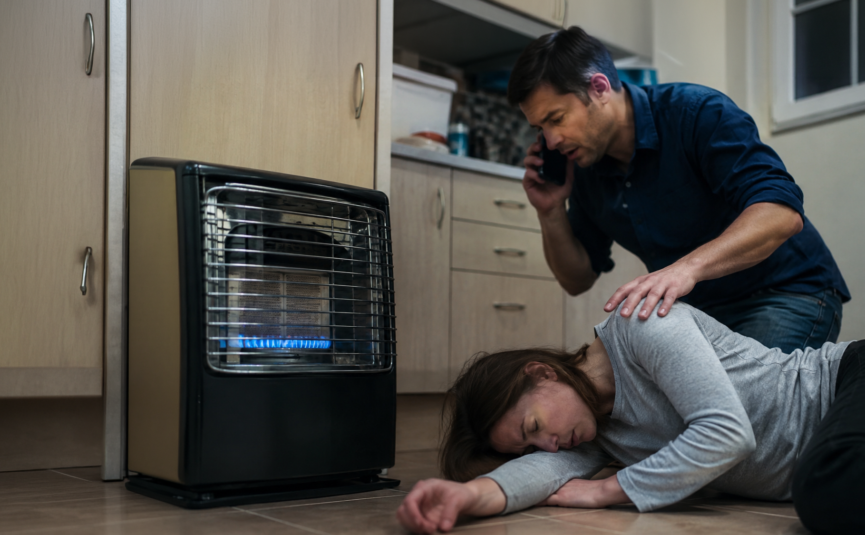
Carbon monoxide is often called the silent killer because it is a poisonous, colourless, odourless and tasteless gas. Most people don’t realise they are being exposed until symptoms begin—and early symptoms can easily be mistaken for a cold, flu or fatigue.
If your home has a gas heater, gas fireplace, wood heater, attached garage, or you use a petrol-powered generator, a carbon monoxide alarm provides an essential early warning when dangerous CO levels are detected
Carbon monoxide (CO) is a poisonous, colourless, odourless, and tasteless gas produced when fuels such as gas, wood, oil, petrol, or charcoal burn incompletely. It can be released by faulty or poorly maintained appliances, or when fuel-burning appliances are used in poorly ventilated or inappropriate spaces.
Common household sources of carbon monoxide include:
The symptoms of carbon monoxide poisoning are often mistaken for fatigue, stress, dehydration or a cold or flu.
Mild exposure
Moderate exposure
Severe exposure
A carbon monoxide alarm continuously monitors the air for the presence of carbon monoxide using an electrochemical sensor. If dangerous CO levels are detected over a period of time, the alarm sounds, providing an early warning so you can evacuate safely and seek assistance.
For the best protection, install carbon monoxide alarms:
Always treat a carbon monoxide alarm seriously. If the alarm activates:
Because carbon monoxide is invisible and odourless, you cannot tell when the danger has passed. The safest response is always to leave immediately.
A combination smoke and carbon monoxide (CO) alarm provides two essential forms of protection in one compact device.
A combination alarm is a convenient, cost-effective way to enhance your home’s fire and carbon monoxide safety.
Have a question? Visit the Quell FAQ page for answers the most commonly asked questions.
Quell carbon monoxide alarms are stocked at major retailers right across Australia, including
You can pick one up next time you’re already out shopping.
You can also find your nearest retailer by visiting our Stockist page.
When it comes to protecting your home and family, choosing the right smoke alarm is one of the most important safety decisions you can make. While all smoke alarms are designed to alert you to a fire, not all technologies perform the same.
Today, photoelectric smoke alarms are the preferred technology across Australia. In some states and territories, they are now the only type permitted for installation under legislation. Walk into Bunnings today and you’ll find almost every smoke alarm on the shelf is already photoelectric. So, the real question isn’t which technology to choose—it’s which photoelectric smoke alarm is right for your home.
This guide explains the different types of photoelectric smoke alarms available and how to choose the best option for your needs.
With so many options available, we’ve listed the benefits and features of different smoke alarms to help with your selection process.
9V Battery
A practical and affordable option for homes where mains-powered alarms aren’t required. Easy to install without wiring, 9V battery smoke alarms provide reliable early detection of slow-smouldering fires while allowing for quick battery replacement during routine maintenance. They’re ideal for existing homes, rental properties and replacing older smoke alarms.
10-year Sealed Lithium Battery
Designed for convenience, these alarms provide long-lasting protection without the need for annual battery replacement. With a sealed lithium battery that lasts the life of the alarm, they’re easy to install and require minimal maintenance while delivering reliable early warning of slow-smouldering fires. They’re an excellent choice for new and existing homes, as well as rental properties, helping you stay up to date with modern fire safety requirements.
240V Hard-wired
Installed by a licensed electrician, 240V mains-powered smoke alarms provide continuous protection with a backup battery to ensure they continue operating during a power outage. Ideal for new homes and major renovations, these alarms can also be interconnected so every alarm sounds if smoke is detected anywhere in the home.
Interconnected
Interconnected smoke alarms provide enhanced whole-home protection. When one alarm detects smoke, every interconnected alarm throughout the home sounds simultaneously. This ensures everyone in the home receives an early warning, regardless of where the fire starts, providing valuable extra time to evacuate safely. Interconnected smoke alarms are available in both wireless and mains-powered options, making them suitable for both existing homes and new builds.
From 1st January 2027, new legislation becomes law, requiring all existing private homes, townhouses and units in Queensland to be fitted with interconnected photoelectric smoke alarms.
Room-specific protection made simple
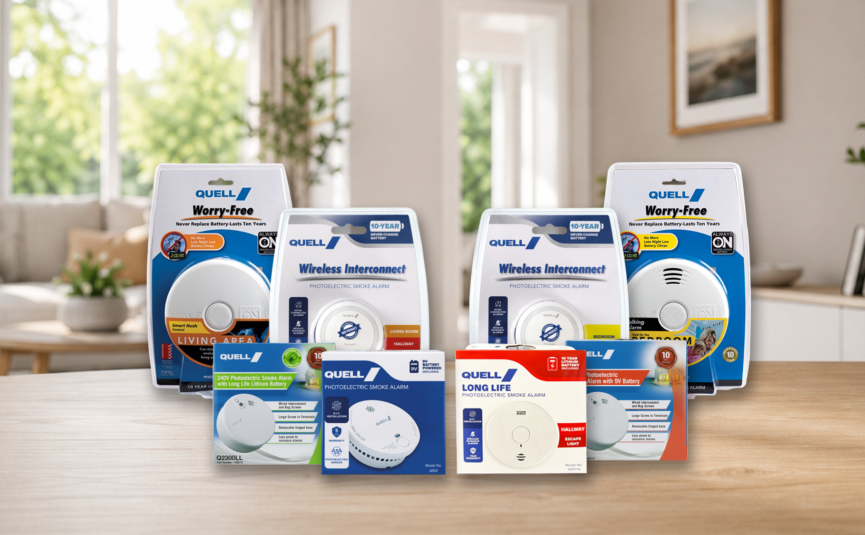
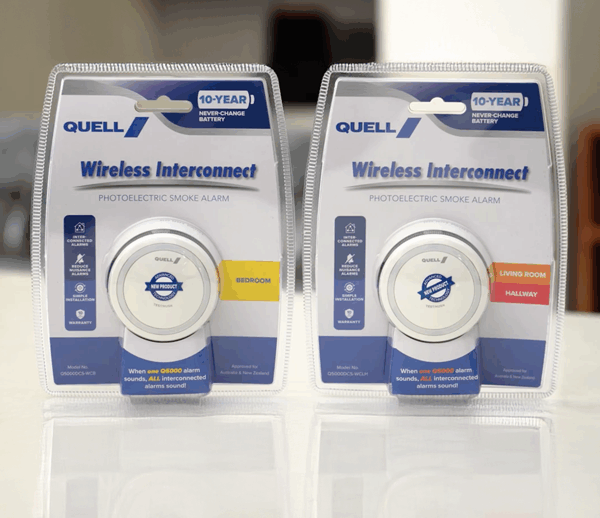
Once you’ve chosen the type of smoke alarm that’s right for your home, selecting the right model is easy. Quell’s room-specific packaging is clearly labelled for bedrooms, hallways, living areas and kitchens, making it easier to choose the most suitable smoke alarm for every area of your home.
When purchasing a smoke alarm, always check that it complies with Australian Standard AS 3786:2014 (or later). Smoke alarms sold through reputable Australian retailers will typically meet this standard, but it’s always worth checking the packaging—particularly when purchasing online.
Choosing the right alarm for each area of your home is easy with Quell’s room-specific packaging. Each Photoelectric Smoke and Carbon Monoxide (CO) Alarm is clearly labelled for its recommended location—such as bedrooms, hallways, living areas or kitchens—helping you quickly identify the most suitable product for every space. This simple, application-based packaging removes the guesswork out of home fire safety, making it easier to protect your family with the right alarm in the right place.
From 1st January 2027, Queensland will become the first Australian state to require interconnected photoelectric smoke alarms in all private homes, townhouses and units. Smoke alarms must be installed:
While legislation varies across Australia, these requirements provide an excellent benchmark for achieving the highest level of protection. For the best protection, Quell recommends:
Regular testing and maintenance help ensure your smoke alarm performs when you need it most. Follow these simple steps:
To watch our helpful maintenance videos and safety tips in the Quell Video Library.
Have a question? Visit the Quell FAQ page for answers the most commonly asked questions.
Quell smoke alarms are stocked at major retailers right across Australia, including
You can pick one up next time you’re already out shopping.
You can also find your nearest retailer by visiting our Stockist page.
Choosing the right smoke alarm depends on your home, local regulations, and the level of protection you want. Here are the main options to consider:
Replaceable Battery
A practical and affordable choice for homes where mains-powered alarms aren’t required. These alarms are easy to install yourself, with the replaceable battery needing replacement at least once a year.
10-year Sealed Lithium Battery
Designed for convenience and long-term reliability, these alarms feature a sealed lithium battery that lasts for the life of the alarm. They’re simple to install and require minimal maintenance, making them a popular choice for many homeowners.
240V Hard-wired
240V mains-powered smoke alarms provide continuous protection with a backup battery allowing them to operate even during a power outage. Installation must be carried out by a licensed electrician in accordance with Australian regulations.
Interconnected
When one alarm detects smoke, every interconnected smoke alarm throughout the home sounds simultaneously. Available in both wireless and mains-powered options, interconnected smoke alarms are suitable for both existing homes and new builds.
From 1st January 2027, new legislation becomes law, requiring all existing private homes, townhouses and units in Queensland to be fitted with interconnected photoelectric smoke alarms.
Room-specific protection made simple
Once you’ve chosen the type of smoke alarm that’s right for your home, selecting the right model is easy. Quell’s room-specific packaging is clearly labelled for bedrooms, hallways, living areas and kitchens, making it easier to choose the most suitable smoke alarm for every area of your home.
For a DIY installation, you’ll need:
If you’re replacing an existing alarm, check the manufacture date on the old unit. If it’s more than 10 years old, replacement is overdue regardless of whether it still appears to work.
From 1st January 2027, Queensland will become the first Australian state to require interconnected photoelectric smoke alarms in all private homes, townhouses and units. Smoke alarms must be installed:
While legislation varies across Australia, these requirements provide an excellent benchmark for achieving the highest level of protection. For the best protection, Quell recommends:
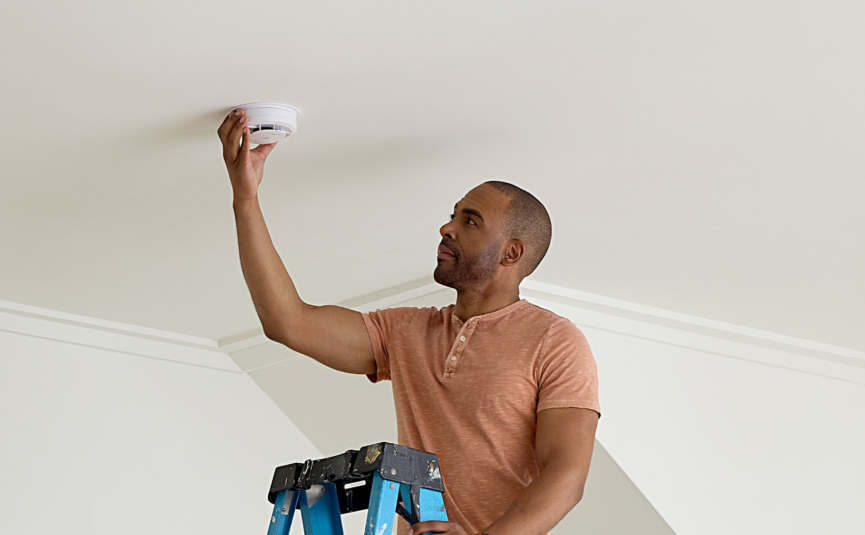
Step 1 – Choose the location of the smoke alarm using the placement guide provided.
Step 2 – Use the mounting base ring to mark the screw holes.
Step 3 – Drill the holes and insert wall plugs if required.
Step 4 – Screw the mounting bracket to the ceiling using the screws and plugs provided.
Step 5 – Insert replaceable battery or follow the activation instructions supplied on the 10-year sealed alarm mode
Step 6 – Twist clockwise or clip the alarm onto the mounting bracket until it locks into place.
Step 7 – Press and hold the test button. The alarm should sound within a few seconds. If it doesn’t, remove the unit and check the battery or activation procedure.
Connect up to 32 Quell Q5000 wireless interconnected smoke alarms to create a fully wireless linked network.
Step 1 – Unpack each wireless interconnected smoke alarm that you plan to install
Step 2 – Choose the location of the smoke alarm using the placement guidance provided.
Step 3 – Use the mounting base ring to mark the screw holes.
Step 4 – Drill the holes and insert wall plugs if required.
Step 5 – Screw the mounting bracket using the screws and plugs provided.
Step 6 – Turn on the interconnect feature of each wireless interconnected smoke alarms, turn each alarm over and slide the switch to LEARN mode
Step 7 – Press the button on the top of 1 alarm only. This alarm will become the HOST and will start to transmit a specific code to each of the other wireless interconnected smoke alarms. As these alarms receive the code, they will flash red.
Step 8 – Once all alarms are flashing red, the interconnect feature is complete.
Step 9 – It is important to remember which alarm is the HOST alarm. Mark it with a sticker or label on the back as a reminder.
Step 10 – Turn over each alarm and turn off LEARN mode.
Step 11 – Now, you’re ready to install each individual wireless interconnect smoke alarm. Place unit on the mounted base and twist clockwise until it clicks and is locked into place. Repeat for each individual alarm.
Visit the Quell Video Library for the full range of instructional videos on our range of photoelectric smoke alarms to ensure help is at hand, 24 hours a day.
Have a question? Visit the Quell FAQ page for answers the most commonly asked questions.
Quell smoke alarms are stocked at major retailers right across Australia, including
You can pick one up next time you’re already out shopping.
You can also find your nearest retailer by visiting our Stockist page.
As many pet parents know first-hand, pets may become unsettled or anxious once a smoke alarm sounds, hiding rather than exiting. Dogs can be trained to respond appropriately to smoke or carbon monoxide alarms going off, and either come to find you when it happens or escape outside themselves.
Here are a few items to consider:
Let’s get prepared. Here are a few items to start your preparation
Like all members of the family, pets are just as susceptible to the dangers of carbon monoxide (CO). But, some pet parents may not know how to spot the symptoms. Kidde is sharing important advice to help people protect their furry family members.
Carbon monoxide (CO) is a colourless, odourless, and tasteless gas that is created by any fuel-burning appliance. When power outages occur during emergencies such as cyclones and storms, the use of alternative sources of fuel or electricity for heating, cooling, or cooking can cause CO to build up in a home, garage, or camper and poison the people and animals inside.
Common sources of CO in our homes include:
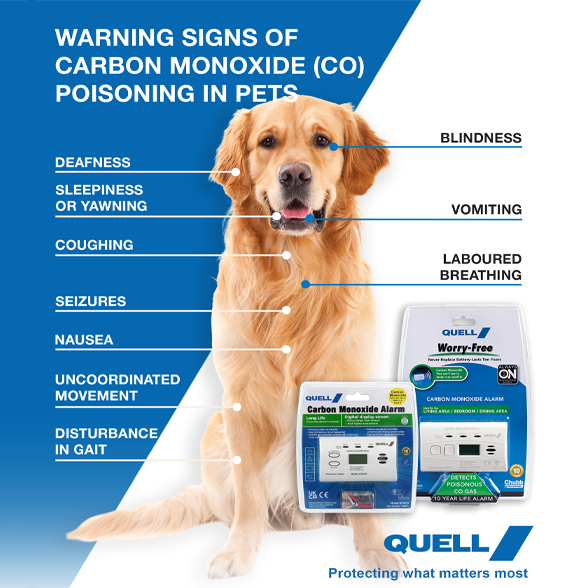
The first signs of CO poisoning in pets are typically nausea and vomiting, followed by difficulty breathing. Most symptoms of CO poisoning or carbon monoxide toxicity in pets are nonspecific, meaning they could easily be attributed to other illnesses. It’s important to keep working CO alarms throughout the home.
Here’s a short list of symptoms:
The best and simplest way to detect the presence of carbon monoxide in your home is with a CO alarm. The way CO travels is different than smoke, it can travel anywhere in the home – even through drywall!
With most homes, one alarm is not ideal protection. Consider installing more than one alarm on each level of your home.
Pay careful attention to rooms where you and your family spend a great deal of time including living areas, bedrooms and hallways.
IMPORTANT: EVERY ALARM MUST BE REPLACED AT A MINIMUM OF 10 YEARS.
In addition to testing alarms once each week and replacing batteries (where applicable), check the installation date too. If you have forgotten when they were installed, there’s a simple fix: look on the back of the alarm for the manufacturing date and add 10 years.
Save contact information for your veterinarian in a place where you and other family members can easily access it, such as your phone contacts or a cloud-based shared file.
Also, be sure your pet’s microchip information is current in case you become separated in an emergency.
Most symptoms of Carbon Monoxide (CO) poisoning in pets are non-specific – they could easily be attributed to other illnesses. It’s important to keep working CO alarms throughout the home, and know the signs in your pets.
People are starting to think about how to stay warm, particularly in the southern states, with homes starting to be warmed with heaters and fireplaces. The kitchen is also starting to be used more instead of BBQs from the summer season. Residential fires occur the most in the kitchen, so always be fire-safety conscious when you’re cooking.
And of course, households are always better protected from fire by following a few fire safety precautions and having a working smoke alarms and carbon monoxide alarms on every level of the home and in sleeping areas, fire extinguishers within reach in the kitchen and garage and a home escape plan.
Stay safe this Autumn with Quell.
When we sleep, our sense of smell and taste significantly diminish. The most effective way to wake someone during a fire is through sound. Having a smoke alarm fitted in every bedroom significantly increases the chances of alerting a sleeping occupant to the presence of fire.
The Nation Construction Code (NCC) stipulates that Smoke alarms must be installed in every corridor associated with a bedroom, or if there is no corridor, in an area between the bedrooms and the remainder of the building. If the bedroom door is closed, the alarm may not be loud enough to wake someone inside, and alarms in other parts of the home may go unheard. In cases where a fire starts inside the bedroom and there is no alarm present, the sleeping occupant may be quickly overcome by smoke, rendering them unconscious before the fire activates an external alarm. This delay can be fatal.
Whilst electrical fires, heaters and unattended cooking are the leading source of residential fires, the average household has 33 lithium-ion battery powered devices in their home, resulting to rapid increase in number of residential fires caused by lithium-ion batteries. You can help prevent incidents in your home by:
From 1 January 2027, Queensland residents must have interconnected photoelectric smoke alarms installed in all private homes, townhouses, and units.
These alarms must be installed in:
✔ Every bedroom
✔ Hallways connecting bedrooms
✔ At least one on every storey of the home
Quell provides a wide range of smoke alarms suitable for bedrooms;
Join families everywhere (including Peppa’s!) to make fire safety a priority at home through Kidde’s Cause for Alarm campaign. As Peppa and her family welcome a new baby, Kidde is sharing expert tips and guidance to help make homes a safer place for everyone. Explore ways to make fire and carbon monoxide (CO) safety fun for your whole family, with educational tools and videos, products, giveaways and more!
The fun SAFETY TOOL KIT includes activity sheets, colouring pages and more? This handy tool kit makes it fun and easy for the whole family to learn about fire and CO safety from the experts at Kidde, with help from Peppa Pig.
Take the SAFETY PLEDGE to be a fire safety helper like Peppa and join Kidde’s Cause for Alarm program!
From the latest safety tips to updates on Peppa and her family, there’s always something exciting happening on Kidde Residential’s social page. FOLLOW ALONG ON OUR SOCIALS to keep up with all the fun! Follow Quell on FaceBook!
From 1 January 2027, Queensland will become the first state or territory in Australia to require interconnected photoelectric smoke alarms to be installed in all private homes, townhouses, and units. These alarms must be located in:
✔ Every bedroom
✔ Hallways connecting bedrooms
✔ At least one on every storey of the home
Interconnected smoke alarms offer enhanced safety by alerting all alarms across the home when smoke is detected in any one location. This ensures that occupants are warned of danger—even if they are in a different room or on a different floor—providing critical time to escape.
When we sleep, our sense of smell and taste significantly diminish. The most effective way to wake someone during a fire is through sound. The NCC stipulates that smoke alarms must be installed in every corridor associated with a bedroom, or if there is no corridor, in an area between the bedrooms and the remainder of the building. However, if the bedroom door is closed, the alarm may not be loud enough to wake someone inside, and alarms in other parts of the home may go unheard.
In cases where a fire starts inside the bedroom and there is no alarm present, the sleeping occupant may be quickly overcome by smoke, rendering them unconscious before the fire activates an external alarm. This delay can be fatal.
Installing them throughout the home, especially in sleeping areas, offers your family the best protection in the event of a fire.
Protect what matters most with Quell’s Q5000 DIY Wireless Interconnect range. Built to withstand Australia’s harshest conditions and ideal for quick installation, it features a sealed 10-year battery—eliminating the hassle of yearly replacements—and comes backed by a 10-year warranty for lasting peace of mind.