
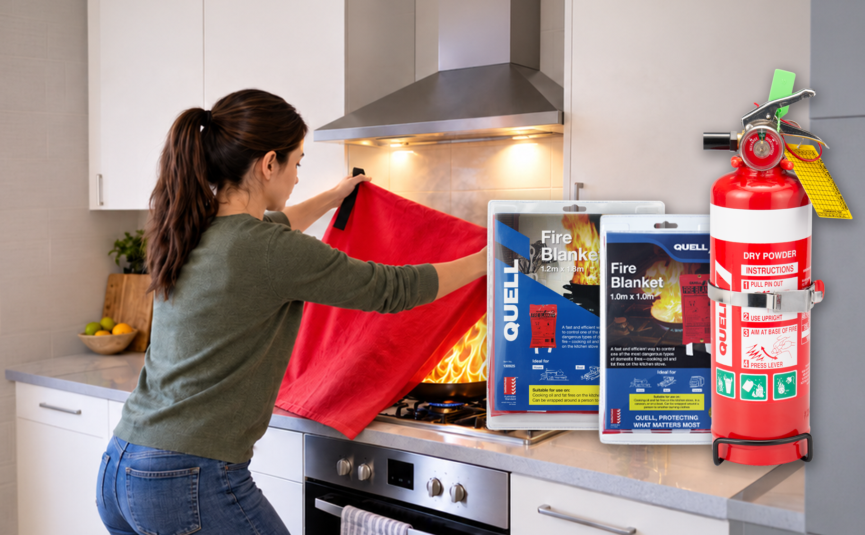
Most house fires start small. A pan left on the stove. A heater against the curtains. In the first few seconds, many can be stopped — if the right equipment is within reach and you know how to use it.
Two things are worth having in every Australian home: a fire blanket and a fire extinguisher.
Fire blankets: The Kitchen Essential
Cooking fires are the most common house fire in Australia, and the most dangerous mistake is throwing water on burning oil — it erupts and sprays burning oil across the kitchen.
A fire blanket is the right response to a pan fire. It smothers the flames by cutting off oxygen, with no mess and no chemicals. Keep it in the kitchen but away from the stove — near the doorway, where you can reach it without leaning over the fire.
How to use a fire blanket
- Pull the tabs at the bottom of the pouch to release the blanket.
- Hold it in front of you with the edges rolled back over your hands to protect them.
- Walk slowly towards the fire and lay the blanket over the pan. Don’t throw it — place it, keeping the edges clear of the flames.
- Turn off the heat at the stove if it’s safe to do so.
- Leave it in place until the pan has fully cooled — fire services advise at least 15 to 30 minutes. Lifting the blanket before the fuel source has cooled will let oxygen back in and reignite the fire
- Call 000, even if the fire appears to be out.
A fire blanket is single-use — once it’s been on a fire, replace it. A larger fire blanket (1.2m x 1.8m) can also be wrapped around a person whose clothing has caught alight: get them to the ground and roll until the flames are out, then seek medical help.
To watch a full demonstration video on how to use a Quell Fire Blanket, go to the link below.
Fire extinguishers: for most other fires
For fires outside the kitchen — a heater, a power board, a rubbish bin, a workshop — a dry chemical powder extinguisher is the practical choice for the home. In Australia these are the red extinguishers with a white band, labelled ABE, which means they are rated for ordinary combustibles (A), flammable liquids (B) and electrical fires (E).
Store it somewhere you’ll pass on your way out — the entrance to the kitchen or the hallway, not inside the kitchen. Check the pressure gauge is in the green now and then and give the cylinder a gentle shake to stop the powder settling.
An ABE extinguisher is not the tool for a cooktop oil fire — the discharge can splash burning oil, and the powder cloud reduces visibility. Blanket for the pan, extinguisher for most other small fires.
How to use a fire extinguisher: PASS
- Pull the pin. This breaks the seal and lets you operate the extinguisher.
- Aim the nozzle at the base of the fire, not at the flames.
- Squeeze the handles to release the powder.
- Sweep from side to side across the base of the fire until it’s out.
- Keep your exit behind you. If the fire isn’t going out, stop and leave.
To watch a full demonstration video on how to use a Quell Fire Extinguisher, go to the link below.
Know when not to fight it
These are for small fires in the first moments. If the fire is bigger than a small bin, if smoke is filling the room, or if you’re not confident — don’t fight it. Get everyone out, close the door behind you, and call 000.
Where to buy Quell
The Quell range includes fire blankets and ABE extinguishers sized for the home. Quell products are available at
- Bunnings
- Mitre 10
- Other leading Australian retailers
You can also find your nearest retailer by visiting our Stockist page.