
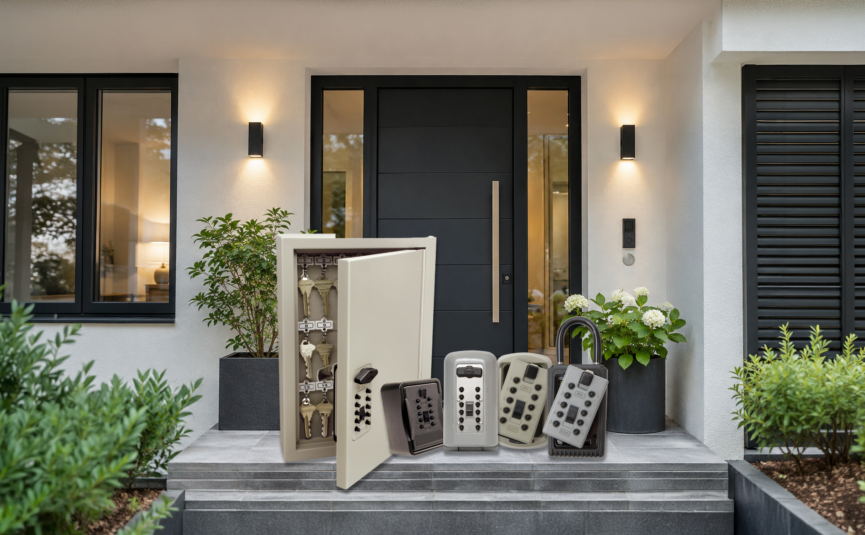
The spare key under the doormat is no secret to anyone. Victoria Police’s home security advice is direct: remove any spare keys hidden outside your home. That still leaves the question of how family, carers or tradespeople get in when you are out. A key safe is one answer: a small lockable box that holds your keys and opens with a combination you choose and share.
Who uses a key safe
- Children arriving home from school before you do
- Family or carers who may need emergency access to an older relative’s home
- Cleaners, pool services and tradespeople on a scheduled visit
- Guests at a holiday property
- You, on the day you lock yourself out
Wall-mounted or portable?
The KeySafe Slimline and the KeySafe Permanent attach to a wall or flat surface with mounting hardware included. The Slimline holds two keys and has an interlocking faceplate that deters tampering. The Permanent holds up to five keys.
The KeySafe Portable holds three keys and hangs on a doorknob, fence, railing or pipe: open the lid, lift the shackle and hang, with no tools needed. The Portable suits short-term needs, such as a holiday rental or a week when the tradies are in.
How many keys, and what kind?
Count the keys you need to store, then look at their size. Two house keys fit a Slimline. A household juggling several keys is better served by the five-key Permanent. For access cards, multiple keys and keys with large handles, there is the KeySafe Pro.
When you want more security: the KeySafe P500
The KeySafe P500 has triple wall construction, stainless steel reinforcements and a long travel latching bolt. Twelve buttons give 4,096 possible codes.
The P500 is also available with an alarm sensor that can be wired to an alarm system. The alarm system can then monitor when the KeySafe is opened and closed, or sound the alarm if the KeySafe is removed from the wall.
Keys for the car, boat or campsite
Heading to the beach or the boat ramp? The KeySafe Auto holds two keys and mounts permanently to a vehicle, for example in a wheel well or on the frame, tow hitch or trailer tongue, with a protective weather cover. The Stor-A-Key Locking Key Case attaches to steel with a magnet, or to other smooth surfaces with the adhesive metal plate supplied.
Where to mount a key safe
A few practical points before you drill:
- Fix the key safe firmly to a solid wall or flat surface
- Choose a spot that is easy to describe to the people who need the key
- Mount the key safe at a height that is comfortable for everyone who will use the buttons
Good code habits
The combination on a KeySafe can be changed as often as needed, so use that:
- Set your own code before the key safe goes into use
- Change the code whenever the people who need access change
- Avoid a code that is easy to guess
- Share the code in person or by phone, not on a note
- Check now and then that the key safe is still firmly mounted
More than a few keys? Lockable key cabinets
For a home or business with many keys, a lockable steel key cabinet keeps keys organised in one place. Kidde key cabinets hold up to 30, 60 or 120 keys and have the depth to take larger keys. Keys hang directly on the hooks, and numbered key tags help keep the keys organised.
Where to buy
Kidde KeySafes and key cabinets are part of the Quell range. See the full Kidde key security range, including the KeySafe P500.
You can also find your nearest retailer by visiting our Stockist page.