
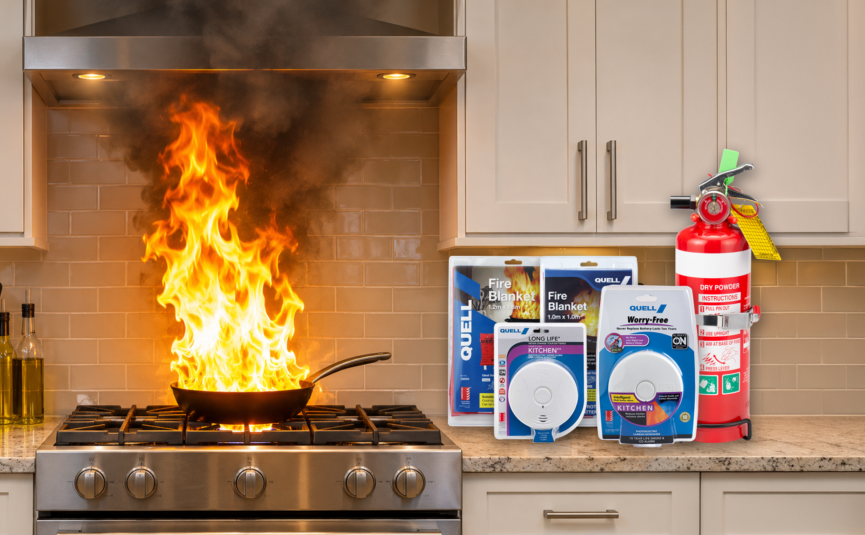
The festive season fills Australian kitchens with roasts, sizzling pans and guests. Fire Rescue Victoria (FRV) says cooking in the kitchen is the single largest cause of fires in the home, and that approximately 40% of house fires start in the kitchen.
Can a smoke alarm go near the kitchen?
Normal cooking may set off a smoke alarm that is too close to the cooktop, so placement matters. Quell’s smoke alarm user manuals say that if a kitchen alarm is wanted, the alarm should have an alarm silence (hush) feature and should not be installed within 3 metres of cooking appliances.
One alarm for smoke and carbon monoxide
The Worry-Free Kitchen alarm and the Long Life Kitchen alarm each detect smoke with a photoelectric sensor and carbon monoxide (CO) with an electrochemical sensor, and each model has a hush button and a sealed 10-year battery.
Why carbon monoxide? Fuel-burning appliances can produce CO if they are faulty, poorly installed, used incorrectly or not ventilated correctly. Quell’s user manuals name appliances used for heating and cooking as the most likely sources of CO inside the home, and Quell’s FAQs recommend a CO alarm in the vicinity of a fuel-burning appliance such as a gas cooktop. Despite the name, the manuals for both kitchen alarms say not to install the alarm within 3 metres of cooking appliances, so never directly above the cooktop.
When the alarm sounds
If the alarm sounds the smoke pattern of three long beeps, first make sure nothing is on fire. If the cause is cooking smoke, press the hush button to silence the alarm for a short time while the air clears. Dense smoke overrides the hush. Never disconnect or disable the alarm to stop the noise; our guide to false alarms has more.
Four quick beeps mean carbon monoxide, not smoke. Quell’s manuals say to move to fresh air immediately and call Triple Zero (000).
Cooking habits that prevent fires
FRV and Victoria’s Country Fire Authority (CFA) advise:
- Stay in the kitchen while you cook. FRV says cooking left unattended is the most common cause of kitchen fires
- Turn off the cooktop, oven and other heat sources before you leave home or go to sleep
- Keep tea towels, paper towels and anything else that can burn at least one metre from cooking and heat sources
- Keep children away from the cooktop and oven, and turn pot handles inwards
- Clean built-up grease from the cooktop, griller, oven and range hood
- Never use water on a fat or oil fire
A fire blanket and extinguisher within reach
FRV says a fire extinguisher and fire blanket should be stored within easy reach but away from the cooking area, and used only if you feel physically and mentally able to use the equipment safely. For kitchen fires involving cooking oils or fats, the CFA says to use a fire blanket, and that an ABE fire extinguisher is not suitable for fires from cooking oils and fats.
The Quell Home Safety Kit pairs a 1kg ABE fire extinguisher with a 1m x 1m fire blanket, which Quell lists as suitable for smothering small cooking oil fires. Our guide to fire extinguishers and fire blankets explains how to use both.
If you don’t feel confident to put a fire out safely, the CFA says to switch off the appliance if it is safe to do so, leave straight away and call Triple Zero (000) once you are outside.
Entertaining over the holidays
For candles on the table, FRV advises a stable, uncluttered surface that won’t burn, at least one metre from curtains and other items that can burn, out of reach of children and pets, and adult supervision. Put the candles out before you leave home or go to sleep, or consider a battery-operated candle instead.
Going away after Christmas? Quell’s smoke alarm user manuals recommend testing smoke alarms when you return from holiday or when the house has been empty for several days.
Where to buy Quell
The Quell range includes fire blankets and ABE extinguishers sized for the home. Quell products are available at
- Bunnings
- Mitre 10
- Other leading Australian retailers
You can also find your nearest retailer by visiting our Stockist page.